Serving Migrants and Upholding Human Dignity: Father Mussie Zerai Yosief Receives an Honorary Doctorate
Montreal
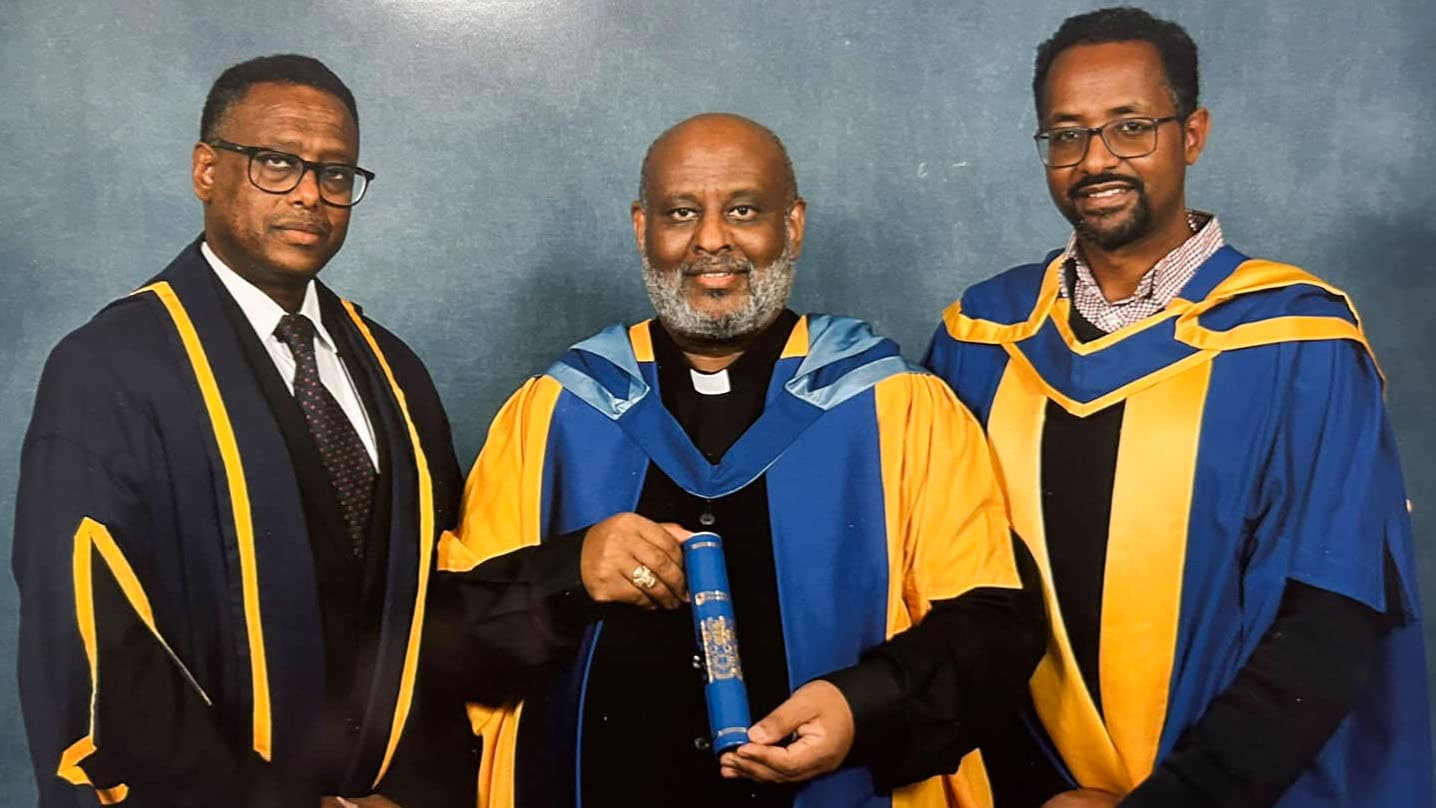
Fr. Mussie Zerai Yosief, a priest at the Missione Madre dei Cristiani parish in the Archdiocese of Montreal, recently received an honorary doctorate from The Open University in the United Kingdom, in recognition of his long-standing commitment to refugees and migrants. Having been forced to leave his own native country as a teenager, he has made the accompaniment of vulnerable people a central aspect of his ministry. In this interview, he reflects on his personal journey, the significance of this recognition, and the Gospel call to defend the dignity of every individual.
1. To begin, could you tell us about your personal journey, your priestly vocation, and what led you to dedicate yourself to supporting refugees and migrants?
I was born and raised in a practicing Catholic family. From the age of 14, I wanted to undertake the priestly formation program, but my father was of the opinion that I should wait until I was 18 to make that decision. Meanwhile, my country was at war, and I had to emigrate to Italy at 16, seeking protection. I experienced refugee life in Italy for eight years before resuming my dream of becoming a priest. But upon my arrival in Italy, I met a British priest, Fr. Peter Jaimse Bone, who for 30 years helped unaccompanied foreign minors find safe and protected accommodation. He helped me and also involved me in helping other refugees. This was in 1992. Part-time, I volunteered my time to assist him with languages as a translator for those who didn't speak Italian or English. In 1997, the year of the beatification of Bishop Giovanni Battista Scalabrini, one Sunday I was at home attending the beatification mass. I knew nothing about this bishop, but listening to his story, I was struck by his commitment to Italian emigrants. In 2000, the year of the Great Jubilee, after two years of reflection and prayer, I decided to enter the seminary. I approached a friend, Scardote, of the Diocese of Rome, expressing my desire to become a priest for emigrants. He put me in touch with Scalabrinian missionaries, so I joined the Scalabrinian missionaries in Piacenza at the motherhouse, beginning my studies in philosophy and theology in Rome. Since I am of the Eastern rite, I chose to be trained and ordained a priest in my rite of origin. Therefore, I moved to the Archeparchy of Asmara for the final years of my theological studies at the Pontifical College of St. Stephen of the Abyssinians (Ethiopian-Eritrean) in the Vatican, where I was ordained a deacon in 2009. The following year, on June 19, 2010, I was ordained a priest in the Vatican at the Church of St. Stephen of the Abyssinians.
2. You recently received an honorary doctorate from the Open University. What does this distinction mean to you personally, and what does it mean to the people whose rights you defend?
This recognition, for me personally, is an encouragement to continue standing alongside the vulnerable. For the people whose rights you defend, it is a recognition of their dignity and fundamental rights.
3. Your work with migrants has brought you into situations of great vulnerability, particularly at sea. What experiences have most profoundly shaped your journey and your understanding of human dignity?
Impathizing with their situations—if I were in that situation, what would I want others to do to help me save my life? The command of our Lord Jesus, "Love your neighbor as yourself." Human dignity is not something we give ourselves; it is God who gave us when He created us in His image. Seeing all those faces of young people, children, women, even pregnant women, desperately crying out for help, "Save us!"—all this affects you deeply.
4. How do your Christian faith and your priestly ministry inform your commitment to the rights of refugees and migrants?
My faith drives me to do what I do. If I want to live according to the Gospel, I must be able to see the face of Christ in our most needy and vulnerable brothers and sisters. Our common humanity—our obligation, simply as human beings, not to stand by and watch our fellow human beings suffer unbearable and unspeakable horrors.
5. What, in your opinion, are the main challenges facing those forced to leave their home countries today, and what concrete responses can society offer?
People fleeing their countries not only encounter physical obstacles but also mental and political barriers, indifference to their plight, even the cynicism that criminalizes them. Society's first response is to have empathy for migrants and refugees. From there, many solutions can be proposed at various political, economic, and legal levels. But the first thing is to move beyond indifference and apathy and toward compassion for those forced to leave their homeland by fame or war.
A. Prevent the root causes. B. Protect the most vulnerable. C. Welcome those who have already fled. D. Integrate them into society by creating spaces for communion and inclusiveness in all areas of civil life, avoiding the creation of ghettos.
6. What role can the Church and parish communities play in welcoming, accompanying, and integrating migrants and refugees?
The Church, by its very nature, is a space of communion, therefore it must foster all of this between natives and newcomers. For the Church, the presence of these brothers and sisters is providential, allowing them to live the Charity of Christ and bear concrete witness to the Gospel in an increasingly secularized society. Newcomers bring newness that challenges the Church and society as a whole. The Church must be a tool for dialogue and mutual acceptance, not demanding forced assimilation, but recognizing each person's uniqueness and seeking common ground on which to build civil and religious coexistence.
7. What message would you like to share with the faithful of the Archdiocese of Montreal regarding solidarity, welcoming others, and defending human rights?
Never be afraid of migrants or refugees. Have an open mind and healthy curiosity to learn what new things they bring, but also have the knowledge of your own faith, culture, and tradition to be able to withstand the inevitable shocks brought by the diversity of new arrivals. Always remember that the rights of the weakest and most vulnerable are not weak rights! Rights are never guaranteed forever; they must be defended even when it seems they are no longer in danger. The Archdiocese of Montreal must sensitize all parishes to pay attention to the needs of society, particularly in defending the most marginalized. Reaffirming their dignity as children of God with the same rights and dignity as everyone else.
For Fr. Mussie Zerai Yosief, welcoming migrants and refugees is not merely a social commitment; it is a concrete expression of the Christian faith and love for one’s neighbor. Through his personal journey and testimony, he reminds us that human dignity is a gift from God that must be recognized and defended—especially when the rights of the most vulnerable are under threat. His message to the faithful in Montreal is a call to move beyond fear and indifference, and to transform our communities into places of encounter, communion, and solidarity.
Comment
Comment
Add new comment