
Walking with the Saints Today: An Invitation to Rediscover the Communion of Saints
Montreal
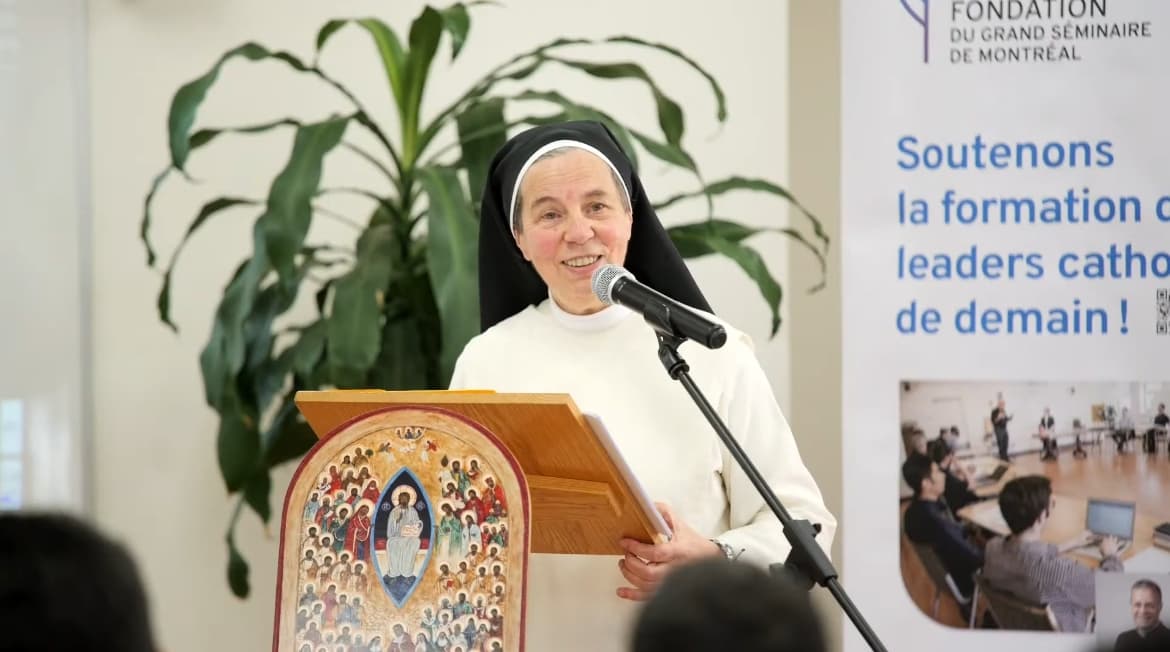
As part of the "Dialogue of Hope" (Dialogue Espérance) keynote series organized by the Grand Séminaire de Montréal Foundation, Sister Catherine Aubin—a Dominican, doctor of spiritual theology, and professor at the Grand Séminaire de Montréal—offered a reflection on the role of the saints in the Christian life. Through a historical and spiritual journey, she invited participants to rediscover the communion of saints as a living reality that unites believers—both on earth and in heaven—in Christ.
Rather than delivering a purely theoretical presentation, Sister Catherine Aubin approached her keynote as a walk, a pilgrimage through Christian history and tradition. From the outset, she reminded her audience that believers are called to keep their feet on the ground while fixing their gaze toward heaven. Far from being an unattainable ideal, holiness is rooted in everyday life, manifesting itself particularly through inner freedom, humility, and charity.
From the Early Martyrs to the Feast of All Saints
Sister Catherine began by tracing the origins of the figure of the "saint" during the first centuries of Christianity. In the New Testament—notably in the writings of Saint Paul and Saint Peter—the term "saints" refers to all baptized believers, who are called to live in Christ. A distinction gradually emerged surrounding the martyrs—witnesses who gave their lives for their faith, such as Saint Stephen and Saint Polycarp of Smyrna.
The memory of these individuals gave rise to commemorative practices, centered on the day of their "birth into heaven" and the veneration of their relics. Following the official recognition of Christianity in the fourth century, the figure of the martyr gradually came to stand alongside that of monks and consecrated persons, whose lives of prayer, renunciation, and faithfulness bore witness to a different form of self-giving.
This development also contributed to the growth of devotion to patron saints, whose intercession with God the faithful seek.
The speaker then recalled the meaning of the Feast of All Saints: it celebrates not only canonized saints or martyrs, but all the elect. This feast highlights the communal dimension of holiness. Each saint reflects something of Christ, yet no single individual expresses Him in His entirety. It is together, as members of the same Church, that believers are called to form a living body.
The Communion of Saints: A Reality That Unites Us
At the heart of the lecture was the article of the Creed: "I believe in the communion of saints." Sister Catherine Aubin presented its three complementary dimensions.
The first is communion in holy things—most notably the sacraments and the Eucharist—which nourish the Christian life. The second is communion among holy people—that is, the members of the Church, united through baptism. Every baptized person is thus called to desire holiness and to grow in their relationship with Christ.
Finally, the third dimension is communion with the saints in heaven. Because Christ is the head of one and the same body, believers remain united even beyond death. This communion is rooted in the sharing of spiritual goods and in the charity that binds all members of the Church together.
The speaker also clarified that saints are not prayed to as if they were gods; rather, the faithful entrust themselves to their intercession before God. Their presence is not merely a matter of historical memory; it remains alive within the life of the Church and accompanies believers on their journey.
The Saints Continue Their Mission in Love
To explore this dimension further, Sister Catherine Aubin drew upon the thought of Adrienne von Speyr—a Swiss physician and mystic who was a close associate of the theologian Hans Urs von Balthasar. Referencing, in particular, *The Book of All Saints*, she described a vision of eternal life in which the saints do not cease their mission after death.
In heaven, they continue to carry out—through love and intercession—the mission that defined their earthly existence. Their vocation, therefore, does not end with their passing to God; it continues in service to the Church and the world. Holiness in Daily Life: Humility and Charity
Discussions with the participants touched upon several topics, including interreligious dialogue, prayer for the deceased, the intercession of the saints, and how to live out holiness within the realities of everyday life.
When asked how one might progress along this path without becoming exhausted, Sister Catherine placed particular emphasis on humility and concrete acts of charity. Holiness does not consist of performing extraordinary feats at any cost; rather, it is about embracing God’s call and allowing it to take shape through the simple actions of each day.
The keynote served as a reminder that walking with the saints means recognizing that we never journey alone. Through baptism, the Eucharist, and charity, we participate in a communion that transcends the boundaries of time and death. The saints go before us and accompany us, reminding us that everyone is called to become—in their own unique way—a witness to the love of Christ.
Watch the talk again
The keynote "Walking with the Saints Today" is available to watch on YouTube.
Comment
Comment
Add new comment