
“Per terre lontane”: A Train Whistle, and Seven Hundred Hearts Tightening
Montreal
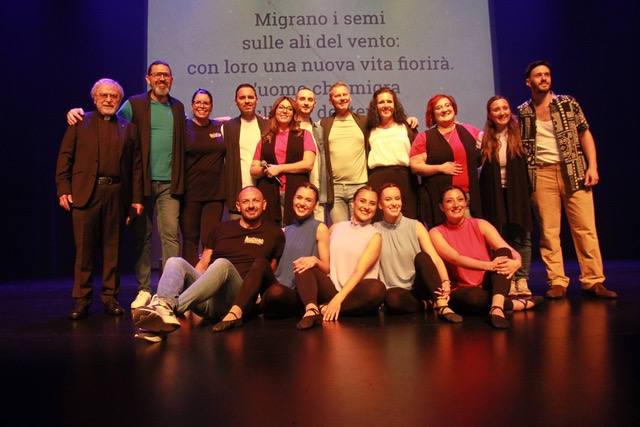
Organized by the Archdiocese of Montreal’s Office for Cultural and Ritual Communities, the musical Per terre lontane was presented as an initiative to raise awareness about the realities of migration, welcome, and solidarity. This theme resonates deeply within our diocesan Church, where first-generation immigrants, their children and grandchildren, and many newly arrived families all contribute to the richness and vitality of parish life. By revisiting the journeys of migrants from both the past and the present, the production invited audiences to recognize that the challenges, hopes, and pursuit of dignity experienced by migrants remain as relevant today as ever.
There is a moment, in the opening minutes of “Per terre lontane,” when the darkness becomes complete, and then, very slowly, a locomotive's whistle breaks the silence. That simple sound was enough, on June 28 in Montreal and July 2 in Toronto, to make entire audiences shudder. But that century-old train is only a starting point: the show quickly moves toward today's deserts, seas, and reception centres, carried by fifteen young performers in front of nearly 700 spectators, from grandparents to grandchildren.
An Italian migrant who arrived in Canada in the 1960s said, leaving the Montreal theatre, that he had seen his own father again on that platform: “Tonight, for the first time, I cried without shame in front of my wife and grandchildren.” A memory carried in silence for more than sixty years — yet the show never lingers only on that old memory: it keeps reminding us that the same fear of leaving, the same hunger for dignity, are being lived again today, elsewhere, with other faces.
On stage, the fifteen performers do not act out migration from the outside; they live through it, past and present alike. In the most intense moments — a desert crossing, an arrival on a distant shore, the cardboard suitcases of a bygone station — voices trembled and eyes filled, without ever losing the thread of the song or the step of the dance.
It is in the audience that this bridge between yesterday and today becomes most moving. A young South American migrant, in Canada for barely eight months, recognized in this hundred-year-old story exactly what he is living through right now: “It made me feel less alone. History repeats itself, but so does hope.” A granddaughter of migrants, born in Montreal, called her grandmother right after leaving the theatre — and for the very first time, her grandmother told her about the crossing, the fear, the hunger, as if that evening had finally let yesterday's story meet today's.
The evening closes with a line spoken together by all fifteen performers: “Let us try to go... beyond every border.” Rooted in the legacy of Saint John Baptist Scalabrini, “Per terre lontane” brought together, for one evening, descendants of earlier migrants and today's newly arrived ones on the same bench — a reminder that a single train whistle can still, more than a century later, bring people to tears, and to hope, together.
By Alessandra Santopadre
Assistant, Office for Cultural and Ritual Communities
Coordinator, Sponsorship Program for Refugees and Asylum Seekers
Archdiocese of Montreal
Comment
Comment
Add new comment